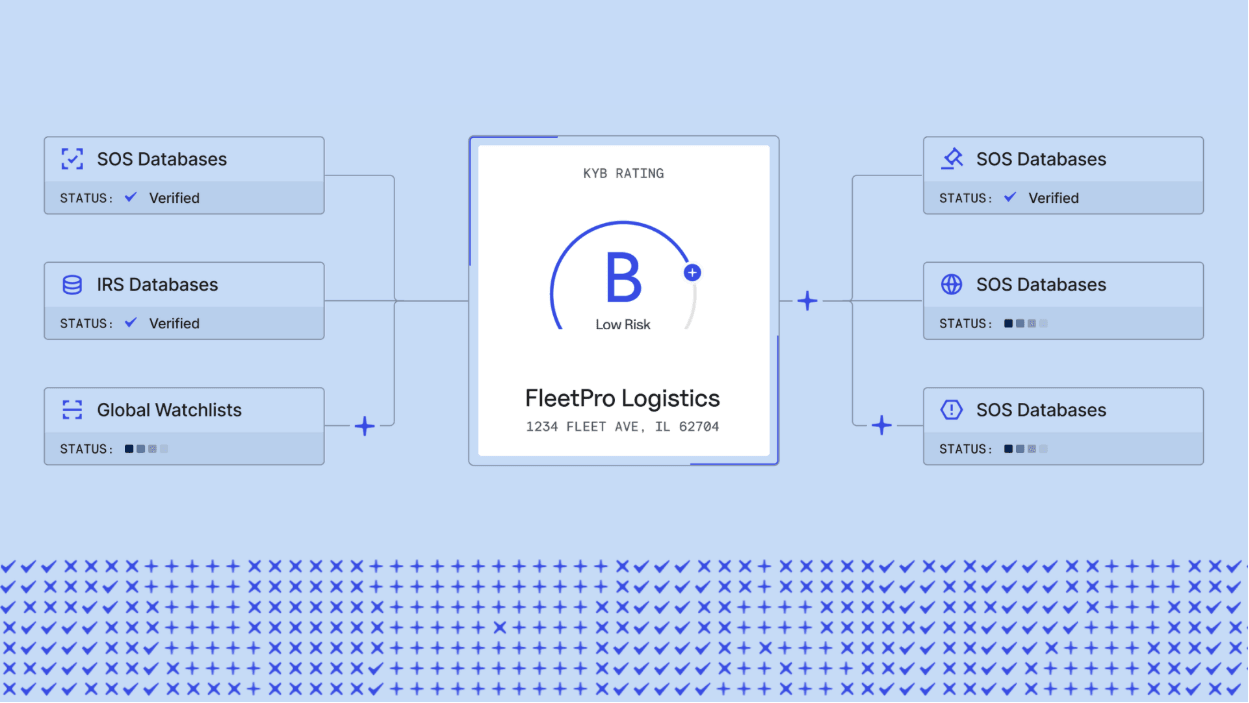
Verifying a business is harder than verifying a person, and the reason is structural. A person is a single identity that is hard to fake. A company is an abstraction, a legal name on a registration, an address that can be rented by the month, a tax ID, and ownership that can be layered until no one is obviously accountable. A business that exists only on paper can clear a casual check as easily as a real one.
That gap is the problem KYB exists to solve, and getting the judgment right or wrong cuts both ways. Verify a legitimate business quickly and you win a good customer with little friction. Clear a fraudulent one and you take on its legitimacy as your own exposure, because the account or credit line you extend lends it your institution’s credibility and makes it look real to everyone it deals with next. This guide covers what KYB is, how it differs from KYC, what a full check involves, the rules behind it, why it is hard, and how modern verification runs it in one call. It ends where verification is heading, toward the AI agents now transacting on companies’ behalf.
Key Takeaways
- KYB (Know Your Business) verifies that a business is legitimate, confirms who owns and controls it, and assesses the risk of working with it before you take it on.
- KYB usually contains KYC, because verifying a company means verifying the people who own and control it.
- A full check has five parts, covering entity verification, beneficial ownership, watchlist screening, standing and financial health, and ongoing monitoring.
- No single law names KYB, but the Bank Secrecy Act and FinCEN’s CDD Rule require it. The 2025 rollback of Corporate Transparency Act reporting changed who files ownership with the government, not a bank’s duty to verify the businesses it onboards.
- Verified against primary-source government data, KYB runs in one automated call instead of days, and the same foundation extends to Know Your Agent (KYA) for AI agents.
What Is KYB?
KYB, or Know Your Business, is the process of verifying that a business is legitimate, confirming who owns and controls it, and judging the risk of working with it before you enter a relationship. Banks, fintechs, lenders, payments companies, and B2B platforms use it to confirm that a corporate customer or partner is real and safe to deal with.
A KYB check works through three questions in sequence, starting with the entity itself. Does it exist and is it registered? Who controls it? And is there anything about the business or those people, sanctions, litigation, or financial distress, that should change the decision? Clear all three and you have a verified business. A gap in any one is a flag to investigate, not an automatic no.
KYB vs. KYC: What's the Difference?
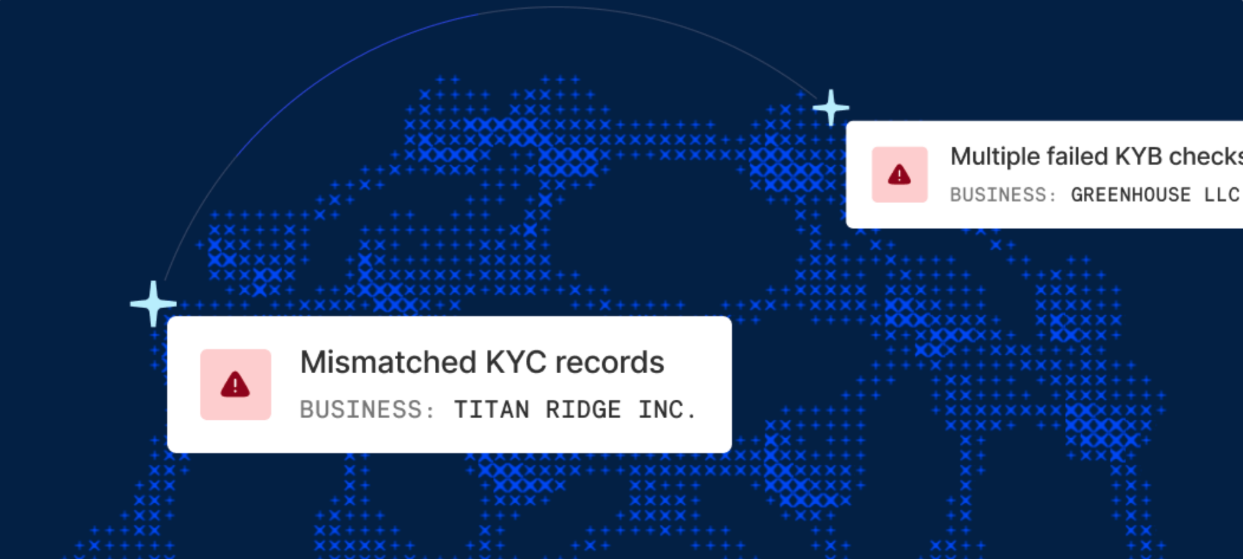
KYC (Know Your Customer) verifies a person, while KYB verifies a company. The difference matters because a company is more complex, and can sit inside layers of parent entities, subsidiaries, and owners who own other owners, any of which can hide a bad actor. That is why KYB usually contains KYC. To verify a business you have to verify the people who control it, which means running identity checks on its officers and beneficial owners.
| KYC | KYB | |
|---|---|---|
| Subject | An individual person | A business entity |
| Verifies | Identity, address, ID documents | Entity registration, ownership, standing, risk |
| Typical sources | Government ID, credit header, biometrics | Secretary of State, IRS, watchlists, court records |
| Complexity | One person, one identity | Layered ownership, multiple registries, connected people |
| Relationship | Can stand alone | Contains KYC checks on the business’s owners |
Why KYB Matters
The alternative to KYB is deciding blind, or falling back on slow manual review. Done well, it pays off on three clear fronts: meeting your compliance obligations, keeping fraud out, and converting more good customers.
Compliance: Meeting AML and Due-Diligence Obligations
Regulated firms are required to know the businesses they onboard under anti-money-laundering law, specifically the Bank Secrecy Act and FinCEN’s Customer Due Diligence (CDD) Rule, which mandate verifying a business customer and identifying the beneficial owners behind it. KYB is how a firm meets that bar, and how it produces the audit-ready record that holds up when an examiner later asks how a given decision was made. When verification is skipped or done poorly, the exposure is regulatory, and carries heavy fines and enforcement, not just the financial risk.
Fraud Prevention: Stopping Shell and Synthetic Businesses
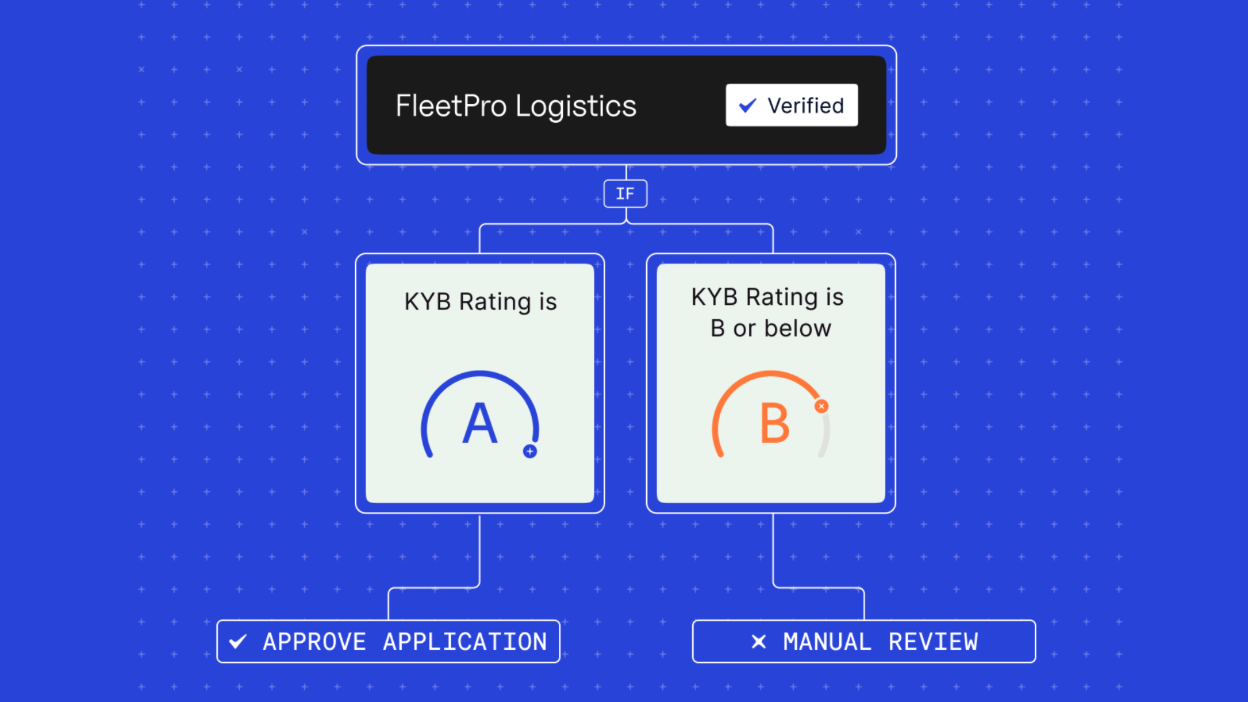
Shell companies, synthetic businesses built around a plausible-looking registration, and stolen or fabricated identities all depend on verification being weak enough to allow them through. A thorough KYB check catches those actors early, before an account is opened, a line of credit is drawn, or money has a chance to move, which is far cheaper and more efficient than clawing back losses after the fact.
Growth: Approving More Good Customers, Faster
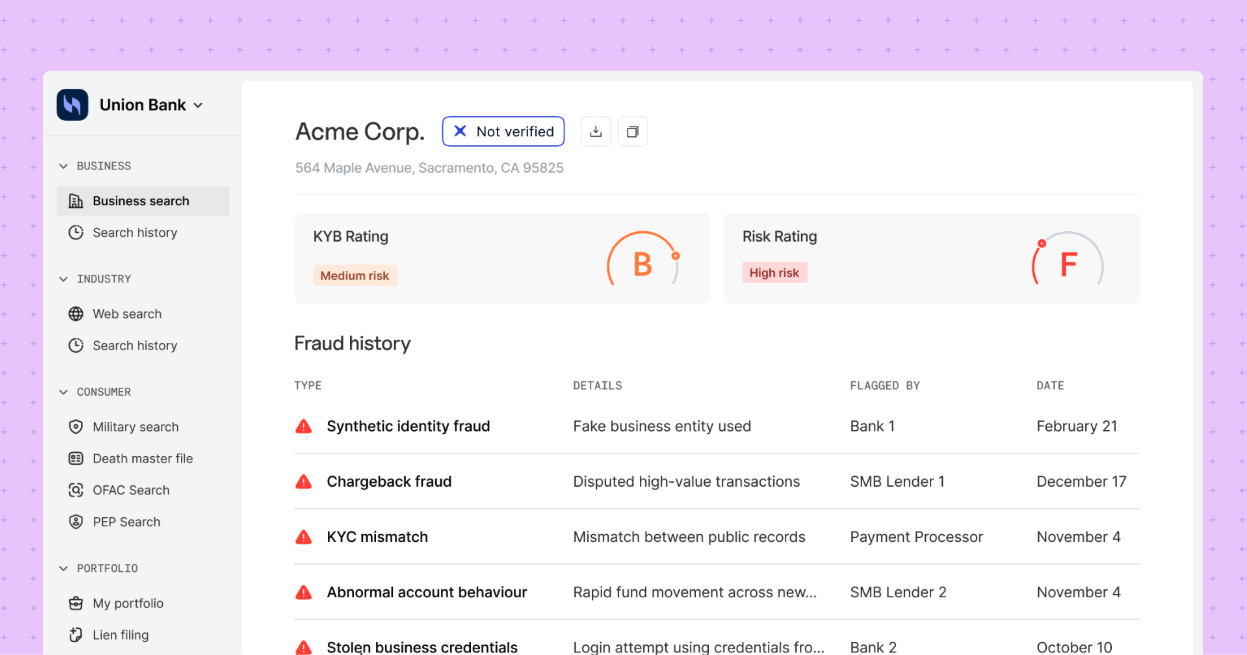
Growth is the value teams most often underrate, where compliance and fraud are focused on what KYB keeps out, growth is about what it lets in. Slow or blunt verification quietly becomes a tax on good applicants, because legitimate businesses get held for manual review, asked for extra documents, or declined outright when the data is too stale or too exact-match to confirm them. Every one of those is a customer, and the revenue attached to them is lost at the door. Fast, accurate verification does the opposite, clearing more of the businesses you actually want in seconds rather than days, which lifts approval rates and conversion while cutting the cost of manual review. The goal of KYB is not to say no more often, but to say yes with more confidence, and to more of the right businesses.
The Core Components of KYB
A full KYB check has five parts, each answering a different question.
Entity Verification
Confirm the business exists and is registered, including its legal name, address, formation date, status, and tax ID, by checking authoritative registries rather than its own paperwork. Verifying the EIN against real-time IRS records and the entity against Secretary of State registries is the foundation everything else rests on. Baselayer runs this as Business Verification and scores it as a KYB Rating, a single score and letter grade for how confident you can be that the business is legitimate.
Beneficial Ownership (UBOs)
Identify the people who ultimately own or control the business and run KYC on them. This is often considered the hardest part of KYB, as ownership may be buried under layers of holding companies, and registered agents can stand in for the true owner on public filings, which is one of the largest drivers of manual review built to obscure it. Under FinCEN’s rules a beneficial owner is anyone holding 25% or more, plus at least one person with real control such as a CEO or managing member.
Risk and Watchlist Screening
Screen the entity and its owners against sanctions, politically exposed person (PEP), and adverse-media lists, since a business can be entirely real and still be one you are barred from serving. What matters is screening comprehensively, covering every officer and owner surfaced during verification rather than only the names the applicant chose to submit. Baselayer screens every party it finds against 42 watchlists that verifies identity, with an adjustable match threshold.
In addition to sanctions and PEP screenings, Baselayer’s Fraud Consortium adds a network layer that no single institution can see on its own. Because default and defraud data is usually siloed, and with fewer than 5% of the suspicious activity reports filed each year ever being enforced, known bad shell companies move freely from one institution to the next. By checking each applicant against Baselayers Fraud Consortium, one of the largest furnished SMB fraud datasets, drawn from 2,200+ financial institutions, companies can surface repeat offenders, synthetic entities, and uncover businesses quietly applying to many lenders at once, before they get in.
Standing and Financial Health
Check whether the entity is active, dissolved, or no longer in good standing, and surface the encumbrances that decide whether it can safely take on credit, because a business can be perfectly real, correctly registered, and still be in no shape to be approved. Baselayer retrieves 100% of UCC-1 and UCC-3 filings and tax Liens that show what a business has already pledged or owes, alongside Lawsuits & Bankruptcies drawn from state and county courts and PACER, which reveal whether an applicant is in distress.
Credit risk is the other half of that financial-health picture, scored as its own Risk Rating and kept distinct from the KYB Rating. The KYB Rating answers whether the business is who it says it is, while the Risk Rating scores how likely it is to repay or default, so you learn not just that a business is real but whether it can carry the credit you are about to extend. Baselayer’s Risk Rating rolls entity standing, liens, litigation, and repayment history into one grade, tuned on proprietary SMB loan-repayment data, so the identity decision and the credit decision each rest on their own evidence.
Ongoing Monitoring
Businesses dissolve, restructure, and change owners after you onboard them, which can turn a business you approved last quarter into one you would decline today. Ongoing monitoring keeps the decision current by re-checking the business over time instead of freezing it at the application. It is also an expectation of the rules, since the CDD Rule asks covered institutions to maintain and update customer information rather than collect it once.
Baselayer Portfolio Monitoring, is a real-time changelog that tracks registration status, standing, liens, litigation, and network fraud signals across the whole portfolio and flags a material change as it happens, far sooner than the business would disclose it, so a dissolved entity or a new lien reaches you well before the next scheduled review.
KYB Regulations and Compliance Requirements
No single law outlines KYB standards outright, but several require regulated firms to verify the businesses they serve in different ways. Several shifts in the regulatory landscape have unfolded between 2025 and 2026.
In the U.S., the Bank Secrecy Act and FinCEN’s Customer Due Diligence (CDD) Rule require covered institutions to verify their business customers and identify the beneficial owners behind them. A February 2026 FinCEN order eased the operational side, so firms no longer have to re-collect ownership at every new account opening for an existing customer, though the duty to identify and verify owners still stands.
Separately, the Corporate Transparency Act created a federal ownership-reporting registry, and that is the piece that was rolled back. A March 2025 rule exempted domestic U.S. companies and U.S. persons, leaving only foreign entities registered in the U.S. to report. The rollback changed who files ownership with the government, not a bank’s own duty to verify the businesses it onboards, and fewer public filings arguably put more weight on primary-source checks.
Outside the U.S., the EU’s Anti-Money Laundering Directives and its new AML Authority (AMLA) impose similar know-the-business, know-the-owner obligations.
Who Needs to Perform KYB
KYB applies to any organization that takes on businesses as customers or partners in a regulated or risk-bearing setting, from banks and credit unions to non-bank lenders, payment processors, fintechs, crypto platforms, and B2B marketplaces. The trigger to perform KYB is usually a moment of commitment between two entities, such as opening an account, extending credit, enabling payments, or entering a partnership where the counterparty’s legitimacy becomes your risk. Simply put, if your business depends on other businesses being real, KYB is what confirms it.
Why KYB Is Hard, and Where Manual Checks Fall Short
On paper KYB is a checklist, but three things make it, in practice, hard to conduct. Business ownership is layered, so tracing its true owners can mean unwinding tiers of holding companies built to hide them. The data on registered agents and individual owners is fragmented across 50 state registries and the IRS, each in its own format. To add further complication, this data quickly goes stale as governments lag in their processes to refresh publically available data sets. As a result, companies that dissolved can still read as active. Done by hand, every application becomes someone cross-referencing databases, and stale or exact-match data produces errors in both directions, false declines that turn away good businesses and false clears that let bad ones through.
How Modern KYB Works: Automation and Primary-Source Data
Automation
Automation removes the tradeoff between thorough and fast, API calls can verify a business against government records, identify and screen its owners, surface liens and litigation, and return a risk score at machine speed. That collapses a check that used to span five or more vendors and several days into one instant decision.
Primary-Source Data
Primary-source data means checking the government record itself rather than a copy of it. Baselayer pulls first-party feeds directly from all 50 Secretary of State registries, refreshed daily or weekly, and validates a business name and tax ID in real time against the IRS. Some provider data can lag the live record by six to fourteen months. That lag is a big detail if a business dissolved last quarter, lost good standing, or picked up a new lien and is still read as clean in a stale copy, and an automated decision is only ever as good as the data beneath it, so checking the primary-source rather than a copy is what makes automation safe to rely on.
The Difference It Makes
The difference between fresh and stale data shows up directly in the results. Working from Baselayer’s primary-source data, Nuvei’s match rates climbed from about 60% with a previous vendor to around 90%, reaching 98% in many weeks. In a head-to-head test, the lender Breakout Finance found Baselayer matched more than 98% of borrower files against roughly 70% for its incumbent, and surfaced seven active liens on a file where the other found only two. Higher match rates mean fewer legitimate businesses wrongly sent to costly manual review, and catching the liens a stale copy misses means fewer risks slipping through. Because every business resolves to a persistent Business ID, that accuracy holds across the whole relationship, not just at onboarding.
Where KYB Goes Next: The Business Behind an AI Agent
KYB was built for a world where there is a human interaction performed, yet this reality is starting to change as AI agents shop, negotiate, and check out on a company’s behalf. The rails for agentic commerce arrived fast, with Stripe, OpenAI, Visa, Mastercard, and Shopify all shipping ways for agents to transact, and NACHA’s 2026 fraud rules now define fraud to include misrepresenting your authority to act for someone else.
When an agent is acting as or representing a customer, the merchant still has to know which business or principal it represents and whether the entity is verified and attributable. This is important because some agents will be trusted representatives of customers and others might not be. Because an agent removes the human interaction, in order for accountability to be enforced, the agent must be traceable back to a verified business or principal for the agentic economy to scale.
Ready to verify any U.S. business in seconds? See how Baselayer confirms businesses against primary-source government data, and extends the same verified identity to the agents acting on their behalf.