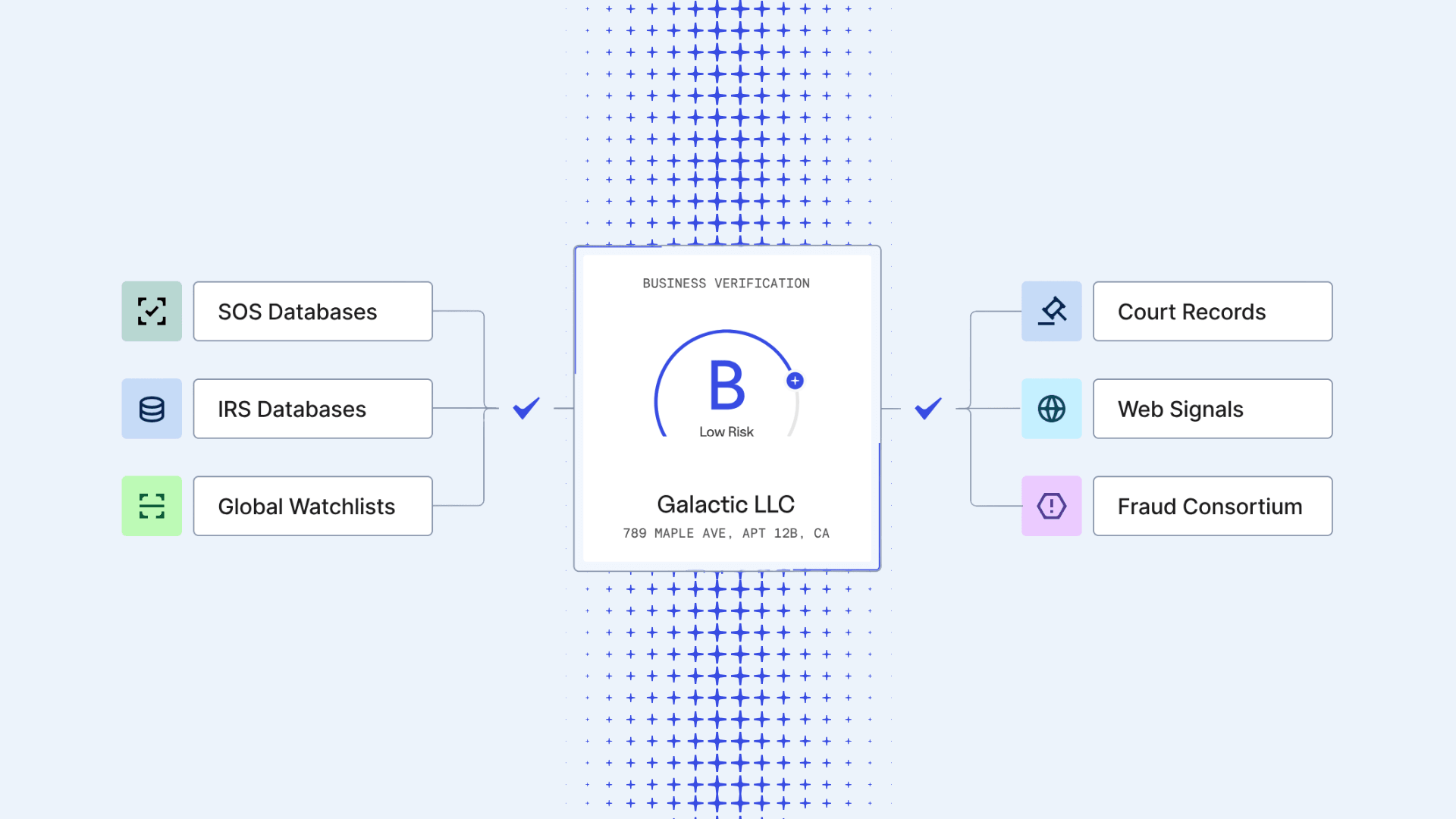
Verifying a business means confirming a handful of details: its legal name, registration, address, tax identity, and the people in control. Any of these can be collected in minutes. What makes a verification sound is not how many details you gather, but how many you can confirm against a live, authoritative source.
The reason is simple. A detail can look correct and still be inaccurate: a name, status, or address that was accurate when it was recorded may have changed since. Most verifications go wrong not because a detail is missing, but because a correct-looking detail was confirmed against a source that no longer reflects the current record.
This guide covers the details that matter most in business verification for a U.S. company, in order of weight, and why the source behind each detail matters as much as the detail itself.
Key takeaways
- Business verification confirms that a company is real, registered, and correctly identified. It is the entity-level foundation of Know Your Business (KYB).
- The details that matter most are the ones you can confirm against a live, authoritative source. A correct-looking detail drawn from a periodic copy is the most common point of failure.
- In the U.S. there is no national business registry, so verification runs through the 50 state Secretary of State registries plus the IRS.
- The highest-weight details, in order: entity existence and status, legal name and type, state or states of registration, registered agent and address, and the EIN.
- Business verification is the foundation the rest of KYB builds on, including beneficial ownership, watchlist screening, and a risk decision.
What is business verification?
Business verification, sometimes called business entity verification, is the process of establishing that a company is real, legally registered, and who it claims to be, by checking it against authoritative records rather than relying on the documents the company provides.
In a compliance context, it is the entity-level foundation of Know Your Business (KYB) (add link). Verifying the entity comes first; identifying the beneficial owners, screening against watchlists, and assessing risk build on top of it. It is also a regulatory expectation. Under the Bank Secrecy Act (BSA) and the Customer Due Diligence (CDD) Final Rule from the Financial Crimes Enforcement Network (FinCEN), regulated institutions must verify the business customers they onboard, along with the beneficial owners behind them, as part of their anti-money laundering (AML) programs.
The principle: a detail is only as strong as its source
When reviewing details, it helps to establish the principle that applies to all of them. Every detail you confirm has two properties: the value itself, and the source and moment it came from. Both determine a detail’s value and worth.
A business detail confirmed against a live authoritative record, meaning the government source that maintains it, carries the most weight because it reflects the current state of the entity. The same detail drawn from a copy that is refreshed periodically carries less, because the record may have moved on since the copy was made. This is why coverage and recency of sources are worth as much attention as the checklist of details itself. The strongest details are the ones tied to a source that keeps pace with the record.
With that in mind, here are the details that matter, and what each one tells you.
The details that matter, in order of weight
-
Entity existence and current status
The foundational detail is whether the entity exists in the official record and what its status is. In the United States, businesses register at the state level, so this means locating the company in the relevant Secretary of State registry and confirming its status is Active or in Good Standing, rather than dissolved, suspended, revoked, or administratively delinquent.
This detail carries the most weight because it is the one most likely to change over time. A company that was in good standing last year may not be today. Confirming status against the live state record, rather than a periodic copy, is what makes this detail dependable.
-
Legal name, entity type, and formation date
Next is the entity’s identity as recorded: its exact legal name, its structure (LLC, corporation, limited partnership, and so on), and its formation date. These should match what the company has represented. Small variations, an abbreviated name or a dropped suffix, are common and usually benign, but the recorded values are the reference point, and they should be consistent with the company’s stated history.
-
State of registration and foreign qualification
Where a company is registered matters as much as that it is registered. Many companies incorporate in one state, commonly Delaware, while operating in others. A business operating outside its state of incorporation should generally be registered as a foreign entity in the states where it does business. Confirming registration in a single state may therefore give only part of the picture, which is why coverage across all 50 states is significant to this detail.
-
Registered agent and physical address
Every registered U.S. entity must designate a registered agent with a physical street address in its state of registration; a post office box does not satisfy this requirement. Confirm that the agent exists and that the address corresponds to a real location, cross-referencing it against mapping services and the company’s own website. This detail is valuable because it ties the entity to a verifiable place, and because it is straightforward to check against independent sources.
-
Federal tax identity (EIN)
Most U.S. businesses hold an Employer Identification Number (EIN), the tax identifier issued by the Internal Revenue Service (IRS). Requesting a Form W-9 captures it. Confirm that the number follows the standard XX-XXXXXXX format and corresponds to the entity on record. The EIN is a central identifier and warrants dedicated verification against IRS records; a fuller treatment is available in EIN verification in KYB (add link).
-
Licenses and permits
Where a business operates in a regulated field, the relevant state or local professional and occupational licenses are a meaningful detail. Confirm any that apply through the appropriate agency or licensing board. Licensing that is consistent with the company’s stated line of business adds confidence; a gap between the two is worth understanding before proceeding.
-
Beneficial ownership
For full KYB, verification extends beyond the entity to the individuals who ultimately own or control it, and includes screening the entity and those individuals against sanctions, politically exposed person (PEP), and adverse-media lists. Ownership is among the more involved details to establish, because it can span several layers of holding companies, and it is the point at which entity verification connects to the people behind the business.
-
Consistency across sources
The final detail is not a single field but the coherence of all of them. The legal name, trade names (DBAs), phone number, address, website, and ownership should align with one another and reflect a genuine, active business. Consistency across independent sources is itself a signal, and its absence is a reason to look more closely.
Where business verification fits in KYB

Confirming these details establishes that a business is real and correctly identified. That is the foundation of Know Your Business, not the whole of it. A complete KYB process adds three things on top of verified identity: identifying the beneficial owners who ultimately control the business, and screening them and the entity against sanctions, PEP, and adverse-media lists; reviewing legal and financial standing, such as liens, litigation, and bankruptcy; and turning the verified identity into a consistent onboarding decision.
That final step is where a score can help. Baselayer expresses it as a KYB Rating: a unified score and letter grade, delivered with reason codes that show how it was reached, reflecting how confident an institution can be in a business’s identity and legitimacy. It is distinct from a credit score, which measures financial health rather than identity. Because businesses dissolve, restructure, and change ownership after onboarding, KYB is also continuous rather than one-time, which is why verification pairs with ongoing monitoring. For the process end to end, see what is KYB (add link).
Why the source decides the value of the detail
Return to the organizing idea, because it is what separates a verification you can act on from one that needs a second look. Two verifications can confirm the same list of details and reach different levels of confidence, depending entirely on the sources behind them.
A verification built on primary-source data checks the government record itself: real-time IRS records for the EIN, and continuously refreshed, first-party feeds from all 50 Secretary of State registries for the entity, not third-party aggregations. It stays close to the record as it stands today. A verification built on a periodic copy confirms the same details as they stood when the copy was made, which is why recency and breadth of coverage are the qualities most worth evaluating in any business verification service or provider.
In one published example, the payments company Nuvei reported that match rates rose from roughly 60% under a previous provider to approximately 90%, and averaged 98% in many weeks, after adopting primary-source data from Baselayer. Higher match rates mean more legitimate businesses confirmed on the first pass and fewer sent to manual review.

Verification at scale
Confirming these details by hand is workable for a small number of applicants. As volume grows, each review requires a person to cross-reference multiple state registries, the IRS, and supporting sources, which adds time before a decision is reached.
Automated verification consolidates the work. A single programmatic query can confirm the entity against primary-source government records, verify the EIN, screen the entity and its officers against watchlists, and return the supporting details together, so more decisions can be made without manual intervention and in less time.
Baselayer, for example, uses its Risk Co.Pilot to perform business verification against real-time IRS data and first-party feeds from all 50 Secretary of State registries, drawing on primary-source data and resolving each business to a persistent Business ID that supports ongoing monitoring after onboarding. The appropriate approach for any institution depends on its volume, risk tolerance, and regulatory obligations.
Frequently asked questions
Baselayer verifies U.S. businesses against primary-source government data. Learn more about business verification.